
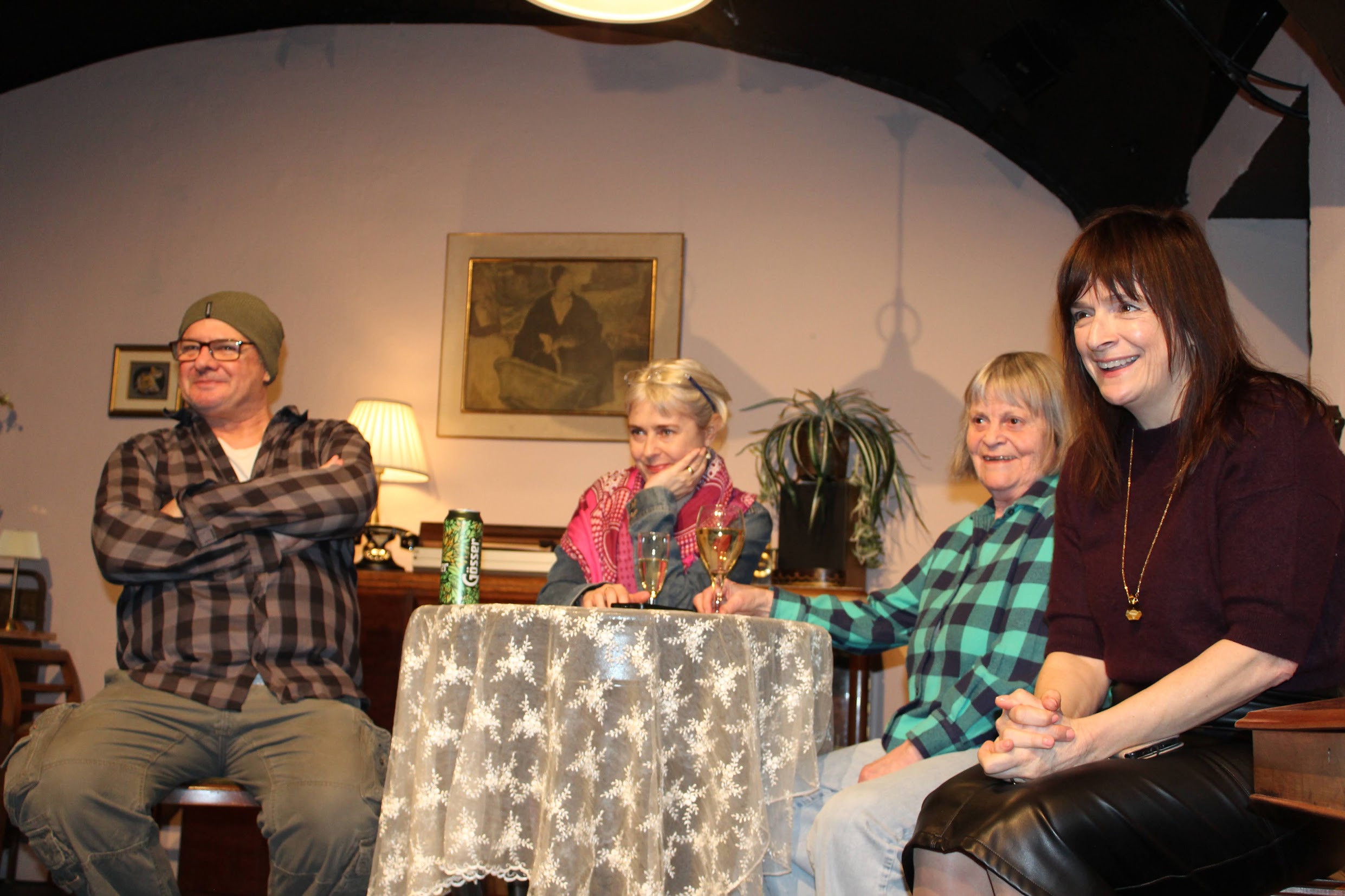
Review of the Drama My Old Lady by Israel Horovitz at Theater Drachengasse
Directed by Joanna Godwin-Seidl – Friday, 13 February 2026
(Photos: © Wolfgang Geissler & Wolfgang Buchta)
By Wolfgang Geissler
Let me begin with a small observation about Vienna.
Vienna is a city in which apartments seem to possess biographies of their own. Walls remember, staircases whisper, and occasionally an inheritance turns out not to be the end of a story but the beginning of one. This thought inevitably comes to mind when approaching My Old Lady, Israel Horovitz’s bittersweet and quietly compelling drama, now presented by Vienna Theatre Project at Theater Drachengasse in its Austrian premiere in English.
The premise appears deceptively simple. Mathias Gold, down on his luck and hoping for a fresh start, travels to Vienna to claim the apartment he has inherited from his estranged father. What he expects is a new beginning and a measure of long-awaited stability. What he finds instead is a home already inhabited, not merely by its occupants but by a past he never knew existed. Two women live in the apartment, and with their presence comes a web of memories, secrets and emotional debts that gradually transform what first appears to be a straightforward inheritance into a far more complex human encounter.
Horovitz has long demonstrated a rare ability to blend humour and melancholy in a way that feels natural rather than contrived. His writing belongs to that subtle territory often described as dramedy, where laughter and sadness coexist without cancelling one another out. The play moves gently between wit and poignancy, revealing the fragile emotional architecture that binds strangers together and reminding us how easily the course of our lives can be altered by unexpected encounters.
At its heart, My Old Lady explores themes that are both universal and quietly intimate: what we carry with us, what we try to bury, and how the past can assert its presence in the most unexpected ways. What begins as a legal and financial matter gradually unfolds into a meditation on regret, forgiveness and the possibility of late beginnings. The play suggests, without sentimentality, that life retains its capacity to surprise us regardless of age and that personal reinvention remains possible even when it appears long overdue.
The Vienna production introduces an additional historical resonance that deepens the play’s themes without altering its essence. During the post-performance discussion, the cast confirmed that the original Paris setting contained references to French political history and the memory of the Resistance, elements that naturally belong to the French context. Transposing the story to Vienna therefore required a careful adjustment of historical references so that the emotional landscape would speak to Austrian audiences. In this new setting, the themes of inheritance, memory and unresolved pasts inevitably echo Vienna’s own long and complex process of confronting the legacy of the Second World War.
Austria’s confrontation with this past was neither immediate nor straightforward. For decades the country understood itself primarily as the “first victim” of Nazi Germany, a narrative that postponed a deeper reckoning with complicity and responsibility. The tensions surrounding this delayed confrontation became particularly visible in the public disputes between Chancellor Bruno Kreisky and the Nazi hunter Simon Wiesenthal, and later in the international controversy surrounding Kurt Waldheim’s presidential campaign in 1986. These moments marked turning points in Austria’s evolving memory culture and signalled a society beginning to grapple more openly with its own history. Without ever becoming a historical drama, the Vienna production quietly resonates with this background, reminding us how European cities carry layers of memory within their walls and how questions of property, belonging and responsibility can echo across generations.
Vienna proves to be an inspired setting for such a story. Few cities understand the idea of layered history better. Behind elegant façades and imposing doors often lie complicated stories and unresolved chapters, making the city itself a fitting silent partner in Horovitz’s narrative. Theater Drachengasse, with its intimate atmosphere, offers the ideal environment for a chamber piece driven not by spectacle but by dialogue, character and emotional nuance.
This Austrian premiere is directed by Joanna Godwin-Seidl, whose work continues to enrich the English-language theatre scene in Vienna. The production stars Bronwynn Mertz-Penzinger, Dave Moskin and Kathy Tanner, who bring to life a story balancing wit, tenderness and emotional discovery. Their performances and the audience’s response were explored further during the post-performance discussion with cast and director.
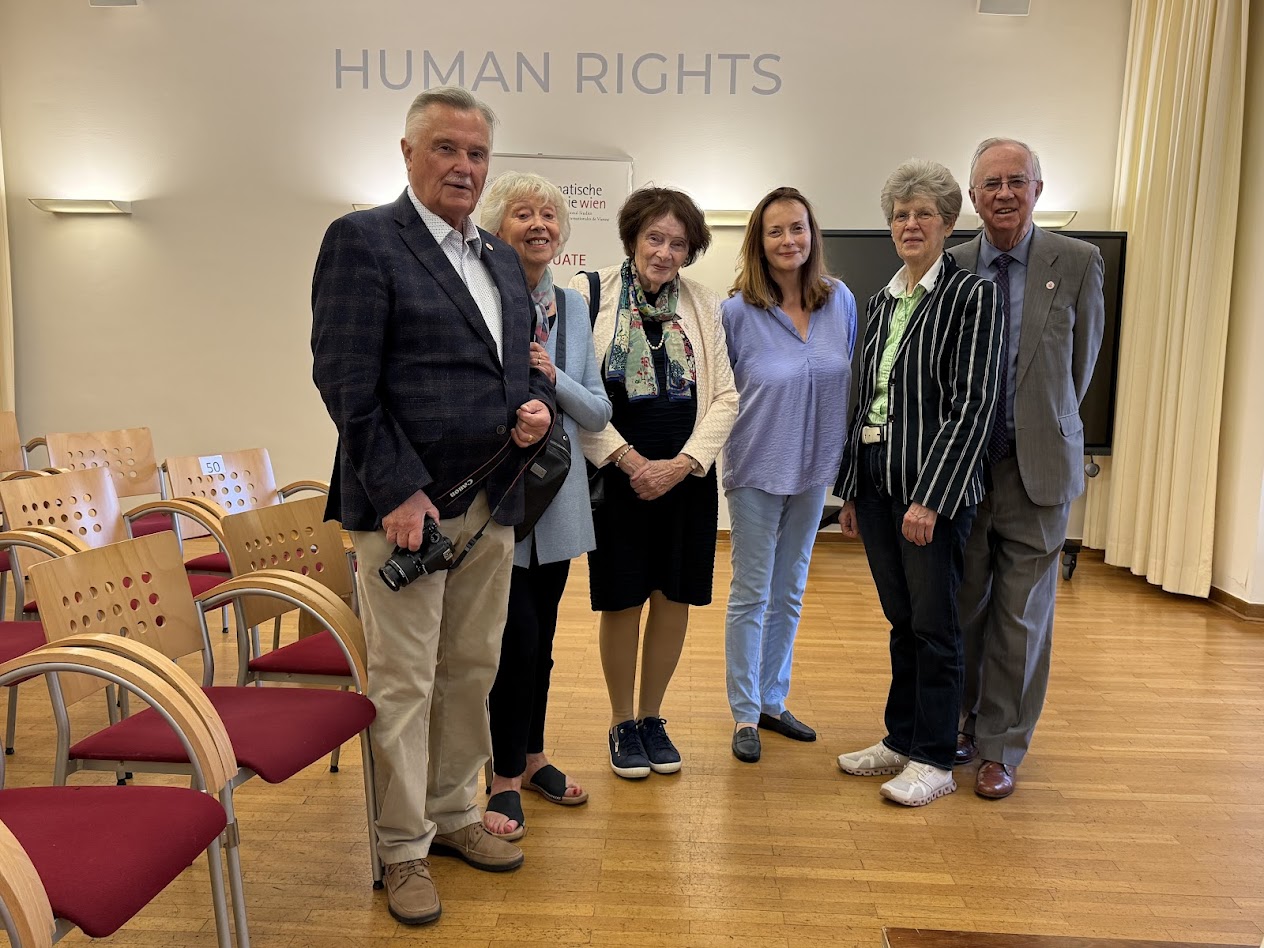
The evening did not end with the final curtain. Immediately after the performance, the cast and director returned to the stage for a lively question-and-answer session with the audience, offering insights into the production and its Vienna adaptation. Only afterwards did the gathering move to the foyer, where members enjoyed a glass of Hochriegl Sekt and the excellent canapés provided by Café Ministerium while the actors mingled informally with guests. The relaxed atmosphere turned the performance into a shared experience that continued well beyond the auditorium.
One of the first questions from the audience addressed the most striking feature of this production: the relocation of the play from Paris to Vienna. The cast confirmed that the original version of My Old Lady is firmly rooted in Paris and originally contained references to François Mitterrand and to the French national memory of the Resistance. Bringing the play to Vienna therefore required a thoughtful reworking of the historical references so that the emotional logic of the story would resonate with a different cultural memory. This adaptation was undertaken by Dave Moskin, who revised parts of the text in consultation with the rights holders. The discussion made clear that this was not a superficial change of location but a conscious dramaturgical decision. The themes of inheritance, memory and the persistence of the past remain universal, yet the historical background against which they unfold inevitably differs between Paris and Vienna.
The conversation also touched on character motivations and relationships, with the cast offering insights into emotional choices within the play. What emerged most strongly from the exchange was the sense of warmth and camaraderie between performers and audience. The discussion felt less like a formal question-and-answer session and more like a continuation of the theatrical experience in a different setting — a fitting extension of a play that invites reflection and conversation long after the lights go down.
The evening at Theater Drachengasse offered far more than a theatrical performance; it became an occasion for reflection, conversation and shared discovery. My Old Lady reminds us that inheritance is rarely limited to property or possessions. More often, we inherit stories, memories and unresolved questions that quietly shape our present. By relocating Horovitz’s play to Vienna, this production allows those themes to unfold in a setting uniquely attuned to the echoes of history, inviting its audience to leave the theatre not only entertained but thoughtfully engaged with the past that surrounds us.
***
What a lovely thoughtful summary – well done Wolfgang and all who visited!