
Why I defended him in 2021 and view him more critically today
By Wolfgang Geissler
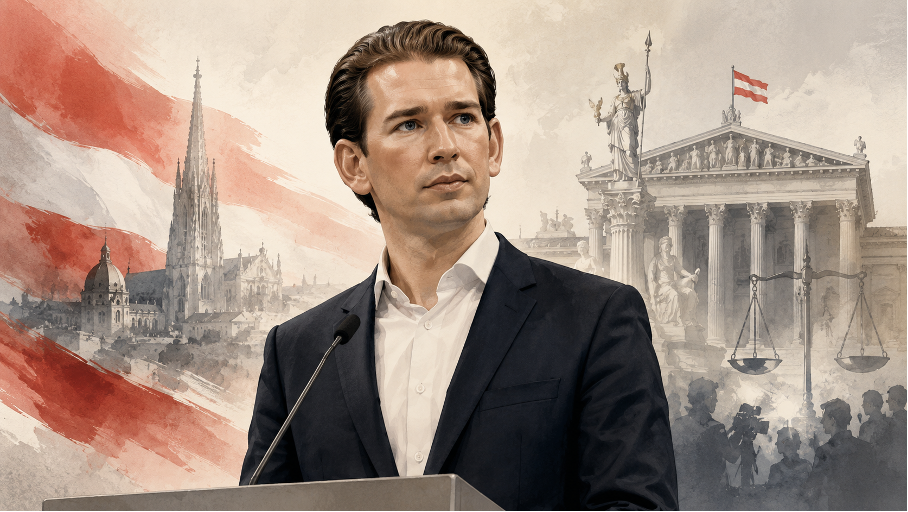
Sebastian Kurz was an exceptionally talented political entrepreneur. He recognised genuine problems, rescued the ÖVP and implemented several worthwhile changes. At the same time, his political system came to rely ever more heavily on power, loyalty and control. In the end, this method destroyed more trust than his policies changed Austria in any lasting way. Kurz was no Austrian Viktor Orbán. Yet his system contained mechanisms which, had he remained in office longer and faced weaker checks and balances, might have led in an illiberal direction.
Few Austrian politicians of recent decades have been discussed with such passion and, at the same time, with so little nuance as Sebastian Kurz. To some, he was a once-in-a-generation political talent who modernised Austria and restored its international profile. To others, he was from the outset no more than a skilful showman whose rise rested on stage-management, manipulation and a hunger for power.
I find both judgements too simplistic.
Perhaps I also find it difficult to reach a clear assessment because I did not experience the Kurz era merely as an observer, but also publicly took a position on him myself. In the autumn of 2021, I wrote an English-language essay entitled Defending Sebastian Kurz. It was never published and, over the years, was almost forgotten.
My introduction at the time was rather dramatic. I wrote of the swift and brutal fall of a politician, of the battle cry ‘Kurz must go!’, and of the Erinyes, the avenging goddesses of Greek mythology, sweeping him away. Today I would phrase some of that more soberly. The reason for writing the essay was nevertheless valid.
An Austrian academic living in Germany had described Sebastian Kurz as a foreign-policy ‘nonentity’ and claimed that he had devoted no time to foreign policy or European integration. I considered that demonstrably false. I did not wish to defend his entire chancellorship, let alone canonise him, but to rebut one specific, sweeping accusation.
On that point I remain firm today: Sebastian Kurz was no political nonentity.
What Sebastian Kurz Was Genuinely Good At
Kurz can be criticised for many things. Political insignificance is not one of them.
He had an exceptional feel for the political mood. He recognised early which issues concerned the public and which questions the established parties were avoiding or addressing only in their customary terms. He could reduce complicated matters to a few comprehensible messages. Necessary nuance was sometimes lost in the process; politically, however, there was no doubt about the effectiveness of this ability.
During his years as State Secretary for Integration, and later as the minister responsible for integration, Kurz treated integration not merely as a social question, but also as one of education, values and identity. In my earlier essay, I referred among other things to language support, integration ambassadors, values and orientation courses, and the simplified recognition of foreign educational qualifications. Not every measure was new or uncontested. Kurz nevertheless gave considerably greater weight to this field of policy, which until then had often been neglected.
As Foreign Minister, he placed particular emphasis on the Western Balkans, relations with Israel, the European Neighbourhood Policy and the OSCE. As its Chair, he visited the conflict zone in eastern Ukraine, supported the European perspective of the Western Balkan states and pursued a policy towards Russia that sought to combine sanctions with a willingness to engage in dialogue. Individual positions were open to criticism; his foreign-policy activity cannot seriously be disputed.
His talent became particularly visible when he took over the ÖVP. Within a few months, he transformed an exhausted, divided party that was trailing in the polls into the strongest political force in the country. He won the 2017 National Council election and improved the result substantially in 2019. Advertising agencies and favourable media coverage alone cannot explain that. It required instinct, discipline, determination and a remarkable feel for voters.
The shift from a coalition with the FPÖ to a government with the Greens also demonstrated political flexibility. Kurz was no rigid ideologue. He could adapt to entirely different partners and build majorities. Those who deny him these abilities are oversimplifying matters.
Migration: The Right Questions, Overly Simple Answers
Kurz owed a substantial part of his success to his stance on migration. Earlier than many other politicians, he recognised that the largely uncontrolled movement of refugees and migrants in 2015 could not be managed indefinitely, either administratively or politically. He also understood that many people did indeed distinguish between helping those in need of protection and permanently open borders. For a long time, some of his opponents refused to accept this distinction and treated almost every objection as a moral failing.
Kurz was right about the fundamental question: a state must know and be able to decide who crosses its borders and who is allowed to remain. What was exaggerated, however, was the later narrative that he had closed the Balkan route virtually single-handedly. That required decisions by several states and developments at European level. Kurz was an important driving force, but not the sole architect.
His tendency to sharpen the rhetoric remained problematic. His remark about the ‘ugly images’ that effective border controls would produce was less cynical in context than his opponents claimed. Even so, it revealed a harshness of language that was politically useful, but could easily reduce human lives to their impact on the daily news cycle.
Kurz often recognised a real problem. His answers – or at least the way they were presented – sometimes became too slick, too self-assured and too much like campaign slogans.
The Political Entrepreneur
Sebastian Kurz was less a traditional Austrian party politician than a political entrepreneur. He did not simply take over the ÖVP; he rebuilt it. The long-established People’s Party became the ‘new People’s Party’, black became turquoise, and a federally structured party with powerful provincial organisations became, at the top, a project heavily centred on one person.
At first, this personalisation contributed greatly to the party’s success. The party acquired a clear face, a consistent language and new momentum. The problem began when loyalty became more important than independence. Kurz surrounded himself with a close circle of young and highly ambitious staff. Every head of government needs people whom he can trust. When, however, dissent is treated as disloyalty, personal allegiance displaces professional experience, and the party serves above all to secure one individual’s position, its political culture changes.
For me, this is the decisive turning point. Kurz was not only exceptionally good at winning power. He and his circle wanted to organise and control it as comprehensively as possible: the party, key appointments, the daily news cycle and the government’s public presentation.
Message Control
Every government wants to present its work in the most favourable light. There is no politics without communication. Under Kurz, however, communication increasingly became the core of politics itself.
‘Message Control’ meant more than professional press work. The aim was to determine as precisely as possible who would communicate which message, at what time and in what form. Ministers were not to diverge from one another, conflicts were to remain invisible to the outside world, and announcements were to set the terms of public debate.
At first, this appeared extraordinarily professional. The government seemed united, swift and capable of decisive action. After coalitions whose partners had contradicted one another in public almost daily, many people found this a relief. Over time, however, the impression grew that presentation mattered more than substance. Politics turned into an almost permanent election campaign.
Government communications, advertising and campaigns grew to enormous proportions. That in itself proves neither a criminal offence nor the enforced conformity of the media. It does show, however, the importance attached to controlling the public narrative. Democracy does not need a government’s perfectly crafted message; it needs dissent, open debate and media willing to say uncomfortable things.
The FPÖ and the Price of Success
The coalition with the FPÖ was democratically legitimate. More than a quarter of voters had supported the party in 2017, and it was not inherently wrong to bring it into government. Kurz wanted to win back FPÖ voters while also forcing the party to accept responsibility in government rather than protest permanently from the opposition benches.
In the short term, the strategy worked. The ÖVP won, the FPÖ entered government, and Kurz largely dominated the coalition. In the long term, the price was higher. FPÖ themes, terminology and portrayals of enemies became still further normalised. Kurz adopted part of its language and political priorities without himself being a traditional right-wing ideologue. In this way, he temporarily weakened the FPÖ as a party while strengthening some of its underlying assumptions within mainstream politics.
Ibiza was not Kurz’s scandal. Heinz-Christian Strache and Johann Gudenus themselves were responsible for their statements and intentions. Kurz did, however, bear responsibility for his choice of coalition partner and for tolerating warning signs as long as the government remained politically viable. He could keep the FPÖ under tactical control, but perhaps underestimated how much its style of politics would also change the ÖVP and the country.
The Limits of His Reform Record
Kurz came to office claiming that he would fundamentally change Austria. There were relief measures, new instruments of integration policy and reforms in individual areas. Yet the major structural problems remained: cumbersome federalism, the long-term financing of pensions, the fragmentation of the healthcare system, the high taxation of labour, and an education system that often perpetuates social differences rather than reducing them.
That cannot be blamed on Kurz alone; Austrian governments have been failing to solve these problems for decades. Nevertheless, his reputation as a great reformer exceeded his actual reform record. He transformed the ÖVP and political communication more profoundly than he transformed the Austrian state.
The Pandemic
At the beginning of the Covid pandemic, the government’s swift and decisive response was understandable and enjoyed broad public support. In an unknown and threatening situation, it was right not simply to wait and see.
Yet the pandemic in particular exposed the weakness of a style of politics that relied on clear messages and personal authority. Scientific understanding changed, forecasts proved wrong, and measures had to be adjusted continually. What was needed was more candid language: we still do not know many things; we are making decisions on the basis of current knowledge and may have to act differently tomorrow.
Kurz instead tended towards categorical statements and grand announcements. The ‘light at the end of the tunnel’ appeared, disappeared and was announced again. Necessary changes of course therefore looked like defeats or broken promises. Not every wrong decision was his; the situation overwhelmed governments throughout Europe. His method of communication, which in calmer times had conveyed strength, increasingly became a burden amid uncertainty.
The Chats and Political Culture
The published chat messages from the circle around the turquoise ÖVP profoundly altered perceptions of the Kurz era. Not every tasteless or arrogant private message is a political scandal. People write things in private that they would never say in public; it would be wrong to turn every flippant remark into an affair of state.
Taken together, however, the chats painted a picture of an environment in which power, appointments, media impact and personal loyalty played an overriding role. Politics sometimes appeared less as service to the state than as a game with winners, losers and obstacles to be removed.
That was certainly not the whole reality of the Kurz government. Nor was it an invention of his opponents. Responsibility for it cannot be delegated entirely to individual staff members. A head of government shapes the culture of his closest circle, even if he does not know every message and is not involved in every matter.
Criminal Law and Political Responsibility
In Sebastian Kurz’s case, particular care is needed to distinguish between criminal guilt and political responsibility. He was acquitted in a final judgment of the charge of giving false evidence before the Ibiza parliamentary committee of inquiry. Anyone who continues to describe him as having been convicted on that charge is stating something false.
Other allegations and investigations that are still under way must be assessed separately. Kurz denies any conduct amounting to a criminal offence; unless and until there is a final conviction, the presumption of innocence applies.
That presumption of innocence does not, however, suspend political judgement. A matter can be politically troubling, morally questionable or harmful to democracy without satisfying every element of a criminal offence. Conversely, an acquittal does not render every criticism of the political culture irrelevant.
His opponents sometimes treat suspicions as proven facts. His supporters, in turn, interpret every acquittal as proof that all allegations and every political criticism were fabricated. Both are wrong.
Was Sebastian Kurz a Victim?
Yes, partly.
From the outset, he was treated with a hostility that went beyond normal political criticism. Some opponents did not want to judge him, but to destroy him politically. His youth, ambition, self-confidence and departure from certain political orthodoxies aroused an almost personal antipathy. My 2021 essay was also written in response to such sweeping disparagement. Anyone who dismissed Kurz as merely a foreign-policy ‘nonentity’ was simply wrong.
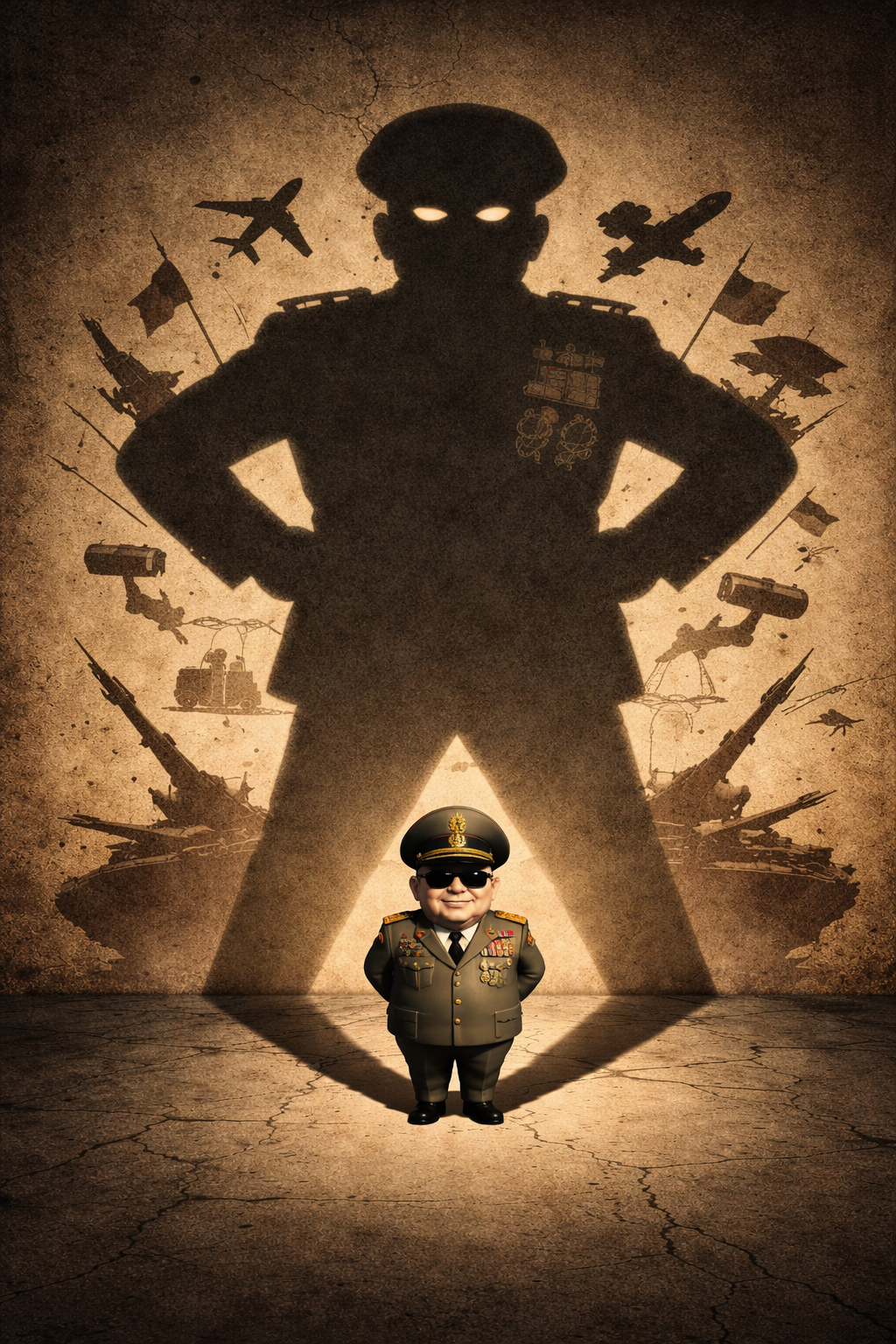
But Kurz was not merely a victim. He himself created a system characterised by intense personalisation, control and a close circle of loyalists. He set high political and moral standards for others and apparently underestimated how strictly he might one day be judged by his own standards.
His opponents wanted to bring him down. Yet Kurz and his own circle supplied a considerable part of the material.
A Comeback – and the Question of Power
Speculation about a comeback received fresh impetus from a meeting with Herbert Kickl in June 2026. Shortly afterwards, Kurz expressly ruled out a return to politics. The hypothetical question nevertheless remains: how would the Kurz system have developed if his chancellorship had not ended in 2021? And what could be expected from a second Kurz era?
The comparison with Viktor Orbán suggests itself, but must not become a facile equation. Orbán began as a liberal opponent of communism and came to power by democratic means. Only over the years did a system emerge in which state institutions, the media, economic dependencies and legal rules were increasingly reshaped in favour of the governing party.
Sebastian Kurz was no Austrian Viktor Orbán.
There is no evidence that he wanted to abolish elections, sideline the courts or replace Austrian democracy with an authoritarian system. His coalitions, first with the FPÖ and then with the Greens, also suggest that he was less the architect of a fixed ideological project than an exceptionally adaptable pragmatist and power politician.
The warning signs lay instead in the method: the personalised party, the close circle of loyalists, centrally controlled communication, and the temptation to treat criticism and scrutiny as obstructions to a project believed to be right. None of these features alone makes a politician an autocrat. Together, however, they can slowly change a democracy.
The real risk of a long Kurz era would have lain less in an open dictatorship than in the gradual emergence of a guided or managed democracy: outwardly still pluralistic, but in reality with the balance of power shifting increasingly in the Chancellor’s favour through media power, government communications, appointments and party-political networks.
I do not believe that Kurz wanted to abolish democracy. More troubling is another question: would he even have recognised the gradual weakening of political and institutional counterweights as an attack on democracy – or regarded it instead as a necessary precondition for efficient government? Those who believe that they alone know the right course can easily come to see dissent not as an essential feature of democracy, but as irresponsible obstruction.
Austria was, of course, not defenceless. The Federal President, Parliament, the judiciary, the media, federalism and the necessity of forming coalitions all provided strong counterweights. Kurz could influence these institutions, but he could not dominate them.
In a second Kurz era, therefore, the decisive question would be whether Kurz had learnt from his failure: whether he could tolerate independent-minded figures alongside him, respect institutional limits, allow open debate and relinquish the claim to control the public narrative completely. Without such a change, a comeback would not merely mean the return of a successful campaigner, but the restoration of a system whose problematic aspects no one could now overlook.
The Caravan Has Moved On
Even if Sebastian Kurz personally returned to politics, the political constellation of 2017 could not be recreated. At that time, he embodied youth, a new beginning and renewal. He could be both a member of government and a rebel against an exhausted grand coalition. That role cannot credibly be played a second time.
Today, Kurz would no longer be an unknown quantity. His abilities are known, as are his methods, his closest circle, the chats and the strong personalisation of the ÖVP. A return would therefore not only raise hopes of decisiveness and leadership, but would also immediately revive the old conflicts and resistance.
Above all, the balance of power has changed. Herbert Kickl is no longer Interior Minister in a coalition dominated by Kurz, but federal party leader and parliamentary leader of the largest group in the National Council – with his own claim to the chancellorship. Many voters whom Kurz won over from the FPÖ to the ÖVP in 2017 have since returned – and may now be more firmly attached to the FPÖ than they were then.
A comeback would therefore create an almost insoluble contradiction. Kurz could be presented as the man who would stop Kickl and prevent a ‘People’s Chancellor’. But if the ÖVP remained behind the FPÖ despite his return, the same Kurz could become the man who delivered a majority for a Kickl-led government. The man who was supposed to stop him would then become his enabler.
Such a double message would scarcely be sustainable. Anyone wishing to prevent Kickl would have to rule out participation in a government under his leadership. Anyone who kept that possibility open could not credibly present himself as a bulwark against him. Moreover, both men want to lead. Kurz’s successful model was based on dominating the centre-right and right-wing camp; Kickl now claims the same role for himself. Any cooperation would therefore quickly become a question of power: who leads whom?
For the ÖVP and the country, too, a return would initially bring chiefly turmoil. The party would have to realign itself around Kurz, the existing leadership would be damaged, and old loyalties and rivalries would re-emerge. Political debate would once again revolve more around him than around the future of the country. Kurz himself would have to risk his successful new professional life for a highly uncertain outcome and reopen every old controversy.
The political conditions that enabled his earlier rise have disappeared. The ÖVP is weaker, the FPÖ stronger, and polarisation greater. Kurz is no longer the young reformer, but a former Chancellor with a past that is both impressive and burdened by controversy. A comeback would scarcely be a new beginning; it would be an attempt to apply a former formula for success once again under entirely changed conditions.
The caravan has moved on.
Sebastian Kurz can return. The Kurz era cannot.
Vienna, 20 July 2026
Great article !! He stumbled on his ambition…