
An Austrian’s Journey, 1969–2026
By Wolfgang Geissler
The Britain I first knew existed in the imagination of a Viennese boy.
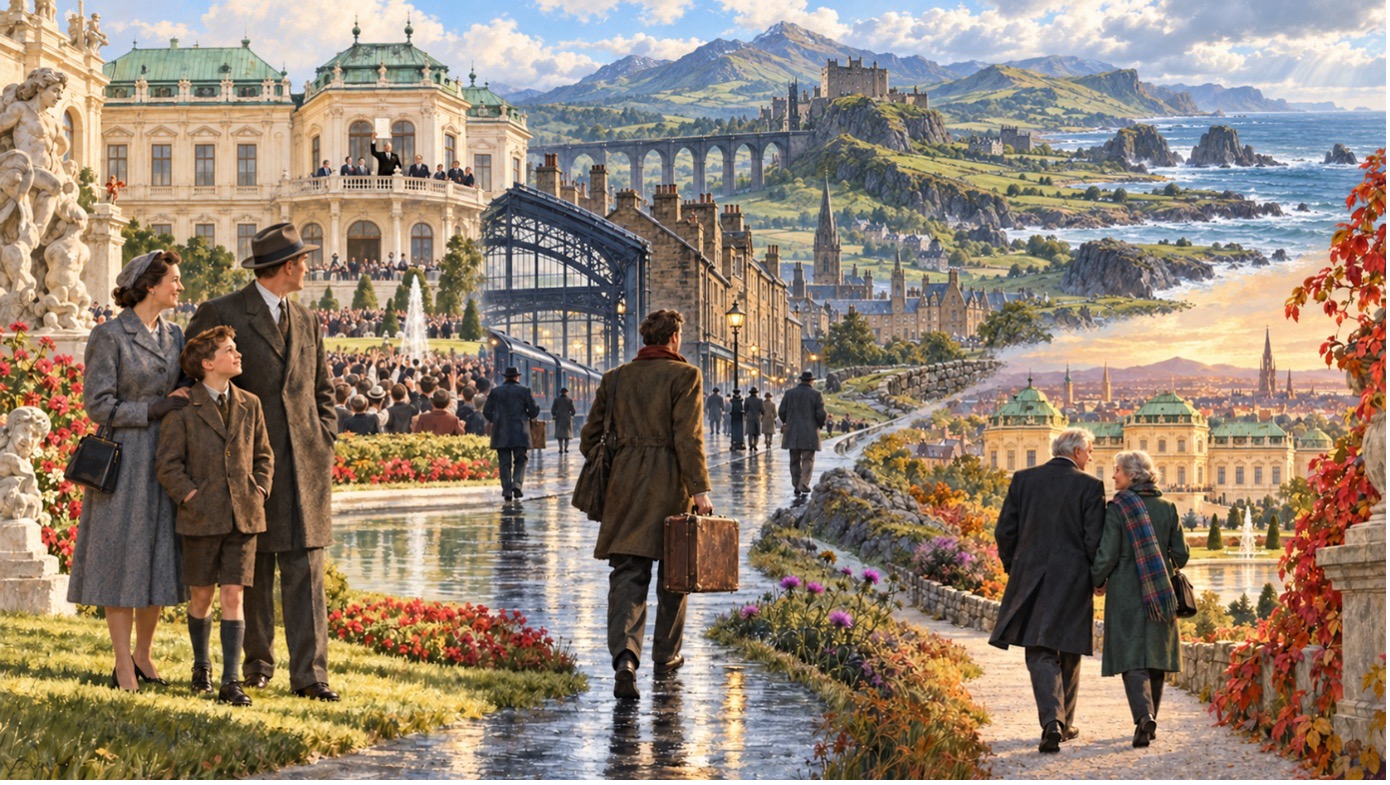
Born in 1943, I grew up in bomb-damaged Vienna, divided among four occupying powers. We lived in the British sector; across the Danube Canal lay the Soviet sector. On 15 May 1955, my parents took me to the gardens of the Upper Belvedere, where thousands of elated Austrians had gathered. The State Treaty, which would restore Austria’s sovereignty, had just been signed. Foreign Minister Leopold Figl stepped onto the balcony and held the document aloft. I was eleven. That day taught me that a country could emerge from catastrophe and begin again. Austria’s renewal was imperfect—we sheltered too long behind the myth of being merely Hitler’s first victim—but defeat and occupation forced us to recognise that an age had ended.
In my young imagination, Britain stood at the opposite pole: the victorious island that had resisted Hitler when almost all Europe had fallen. I associated it with correctness, fairness and self-command—a civilisation in which good manners seemed a form of moral discipline. After a school exchange in Grimsby in 1959, I returned home determined that one day I would live there. Ten years later, in 1969, I did.
I made my life there. Britain gave me a career, friendships and a second home. More importantly, it gave me Mary, my Scottish wife, and our two children, both born and raised in Scotland. The country I had imagined from Vienna became the setting of my adult life.
Yet the picture soon acquired shadows. In Blackpool in 1970, I saw boarding-house notices: “No dogs, no blacks, no Irish.” In Glasgow, a parade of the Protestant Orange Order introduced me to an anti-Catholic sectarianism I had never expected. Mary is a Presbyterian; I am a Catholic. In the language of the time, ours was called a “mixed marriage”. It caused no difficulty between us, but those labels carried social and political meanings I had barely understood.
One incident brought ideal and reality sharply into focus. At Turnberry Hotel on Easter Sunday 1974, while I was duty manager, Jewish guests from Glasgow were served afternoon-tea sandwiches filled with ham, forbidden under Jewish dietary law. Some kitchen staff considered this an amusing joke on “the Jews” and on the “Kraut”—me, the Austrian who would have to answer for it.
Several understandably angry young Jewish men held me responsible and accused me of being a Nazi. My name and accent seemed to confirm their suspicion. An elderly Jewish lady asked when I had been born.
“1943,” I replied.
“So how can he be a Nazi? He was two years old when the war ended.”
She alone had asked for a fact.
That afternoon exposed prejudice and the speed with which people disappear into categories. Yet it also contained the fairness I had admired as a boy. The illusion was not that British fairness existed; I often encountered it. It was that such fairness was automatic and peculiarly British. No country monopolises virtue—or prejudice.
Behind my experience lay a larger historical question. Britain had won the war, magnificently and at immense cost. Austria and much of continental Europe had been compelled to rebuild their institutions and national stories. Defeat, occupation and destruction forced renewal.
Victory did not spare Britain hardship, but it spared the enforced rupture experienced by the defeated states. It preserved admirable institutions, but also habits of command and a story of exceptional independence as empire and economic pre-eminence receded. Britain repeatedly reinvented itself, but never resolved whether its future lay with Europe or apart from it.
Brexit was the eventual answer, and to me the wrong one. It would be contemptuous to attribute the Leave vote merely to ignorance or racism; many voters had genuine grievances. Yet parts of the press and political class had treated Europe for decades as a convenient culprit. “Take Back Control” drew upon the old image of the island standing alone. Brexit was the moment when the distance between Britain’s heroic story of itself and its actual circumstances became national policy.
Our retirement to Vienna in 2009 did not make Britain a closed chapter. One does not live in a country for forty years, marry and raise a family there, and then become indifferent to its fate. What had changed was not my affection but my understanding: The Britain I Thought I Knew had given way to the real and far more complex country in which I had lived.
I returned to Vienna grateful for everything Britain had given me.
Britain remains part of my life. Austria is home.


Hinterlassen Sie einen Kommentar